Apple had Steve Jobs… UX is for the rest of us…

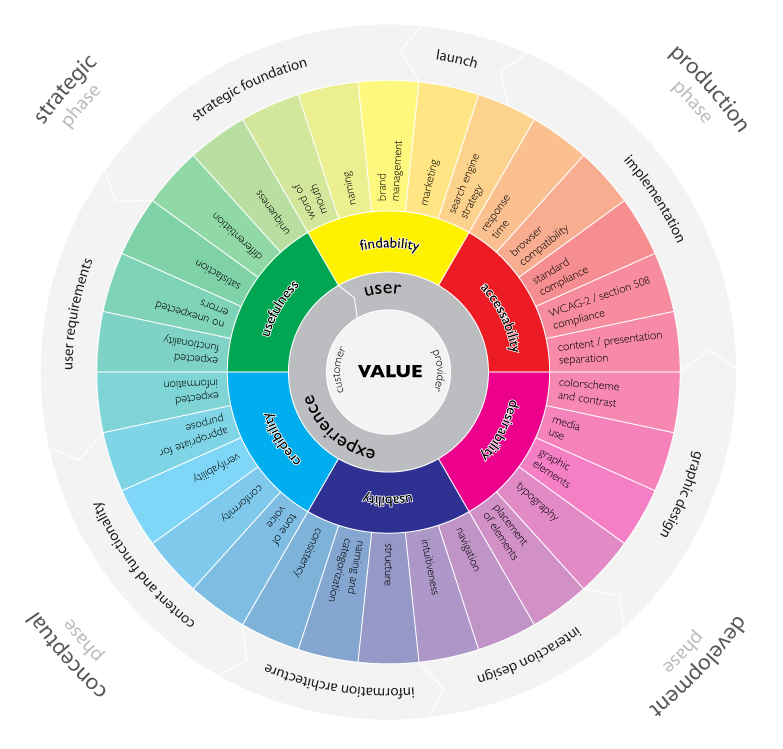
user_experience_wheelUser-Experience-Wheel

You can’t have it both ways. I mean, you might want to have it both ways, you might think that having it both ways, with some finagling, is possible, even though you know that one might, inevitably, cancel the other out, still you can’t have it both ways.

I’m thinking about something I used to tell clients when doing design work, web or print…  I used to tell them about the ‘wants triangle’… that’s what I called it, somebody with a PhD in economics probably came up with it, but I heard it somewhere, picked it up and made it my own. It went something like this: ‘You can have it quick, you can have it cheap, you can have it good… but you can’t have all three, you have to pick two…’

Now, my argument about wanting both is binary, whereas this equation wasn’t. In both cases, though, client/organization/boss had to make a choice. And decisions, for the majority of us upright bipeds, are things of the greatest difficulty.

So, you can’t have it both ways.

That’s the preface.

When we talk about having it both ways what we’re talking about is making the choice between choosing to adopt UX practices or not.

At this point, not adopting UX if you make websites, software, or really any product that somebody has to use, which, I guess, is almost everything from dishwashers to urinal pucks doesn’t make a lot of sense. Admittedly, safety was never a primary concern for most automobile manufacturers, and when safety standards were finally adopted, these rules had to be foisted upon automotive manufacturers; hard to imagine, now, I know, but alas, that was the case… Cars and safety belts go together like peanut butter and jelly. Similarly, the discipline of UX is kind of inseparable from the reality that users are going to use your stuff… so why not include them in the design process of the thing you’re making. Capital idea!

And yet…

You can’t have it both ways. Well, not exactly, but with maturity you can get pretty close.

I’m talking about the initial adoption and investment in UX, which does slow down the traditional process of the CEO or CMO telling you what kind of website or product they want and telling you to go and make it. The discipline of UX builds in layers that could be construed as slowing things down, but really this investment takes the risk out of something not working or being a flop when it eventually gets released or goes to market… the visionary CEO or CMO’s approach doesn’t. Admittedly, they’ll take the hit (sometimes), but it’s  a huge waste and a bummer to bet the farm on single person’s idea.

Achtung! Or, warning!, for our non-German speakers… In the cult of Steve Jobs, of which there are many supplicants, the idea of being a CEO, CMO or product person that has both business acumen and a strong vision is a very common occurrence, in some ways it feels like a plague… Business acumen, you can learn, vision, on par with Henry Ford, Thomas Edison, Walt Disney and Steve Jobs, uhh… yeah, not so much. Is it genius? I don’t know. There was something going on with these folks, their particular epochs, their experiences and also their locations on history’s timeline, intersecting with technology, curiosity, creativity and sheer force of will… the likes of which can’t be manufactured, thus making the likelihood of running into someone like this or your CEO being one of these people very, very slim. Which brings us back to UX.

UX is for the rest of us, i.e. most of us. UX takes practice, organization and structure, that’s why it’s called a discipline. That’s what is so enduring about it. It’s not a quick shot or injection that will make everything good. It’s transformative and transformation is hard; it’s change. It’s putting the users in charge of the design instead of the CEO, CMO or chief whatever officer… where it should be.

This is what I mean when I say you can’t have it both ways. You can’t have a mature UX practice and process in place without putting in the work. You can’t remove the risk of bad design without a mature UX practice.

You can’t have it both ways.

There’s no shortcut to a mature UX practice.
There’s no shortcut for good design.
There’s a symbiosis where each needs the other.

You need these two things for UX success

user_experience_marathon

User experience, like any change, can take a lot of time, a lot of energy and a lot of persistence. Even in those instances when preparation and opportunity intersect change isn’t easy.  I’m talking about UX, but I could be talking about organizational change of any kind. Sometimes, I feel like this is a perspective that comes with age, something that my younger self, wouldn’t have wanted to hear, but my more seasoned self knows as a fact and embraces accordingly.

In order to be successful with UX, you need to put the energy in and you need to be persistent.

The energy comes in many forms. It’s your passion, it’s your vision, it’s your need to share the idea of UX and push the change forward against bureaucracy and those who aren’t willing to accept any change, and those who feel like you’re presenting hurdles, or unnecessary steps when the old way of doing things will do… But you know that UX isn’t just necessary, it’s important to an organization’s ability to change and grow, and perhaps, most importantly, it’s the right thing for your users.

This is where the second part comes in, because without this one, all of the energy in the world doesn’t matter.

Persistence.

Energy without persistent direction will be put into something else when you want to give up, when you get sick of putting the energy in and getting no positive feedback, no return on time and years of your life invested in the change.

Energy and persistence are the 1-2 punch that no change, no matter how great, can resist. Admittedly, this may seem like an over-simplification as change comes in many shapes and sizes, but at the core, if you can persist and direct your energy accordingly you will make great strides as an agent of change.

Change takes time; Pace yourself, treat yourself well and don’t forget the goal. Remember that change is a marathon not a sprint, and today’s setbacks could be tomorrow’s opportunities to stop, reflect and make course corrections. I wish I had somebody to give me this advice as I embarked on changing organizations, but hopefully I can help somebody in a way that would have helped me by writing down these lines.

When you combine energy and persistence UX change isn’t just possible, it’s inevitable.


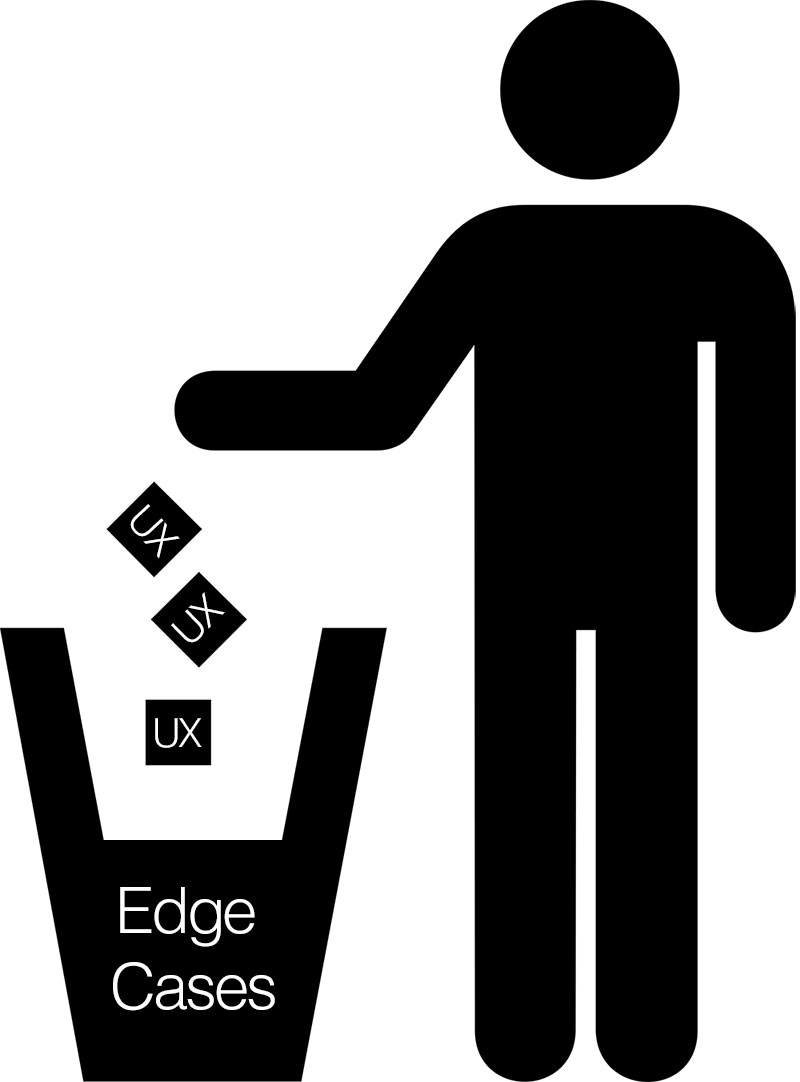
Don’t lose your UX to edge cases

ux_edge-cases

Vital to any user experience are the use cases, but sometimes, it is possible to overthink the design, the product, the software, the website, etc… We’re natural born problem solvers, so when we get in that state of mind it’s easy to find a lot of problems that need solving. The problem here is that we can lose ourselves and our user focus in edge cases.

Edge cases are important and play a vital role in determining how outliers and users in the minority might use your design, but we have to play to the 80/20 design rule: Focusing on the needs of 80% of your users.

That’s not to say that we don’t keep track of that 20% minority, or that we don’t capture use cases and put them in our product backlog, but we can’t prioritize edge cases as if they’re critical to making a design “complete”, when they ultimately prolong the shipping of the design.

Shipping the design gets us valuable user input that’s key to a product evolution and refinement, so getting lost in edge cases not only compromises the timeline, but ultimately focusing on edge cases compromises the user experience for the majority of users.

Focus on the needs of the majority of users, apply the 80/20 rule and design the user experience for the majority of users.

Meet me there… UX design and the user environment

user_experience_environment

User experience design requires an empathic, user-centered design perspective.

You have to meet people where they’re at.

Once you’ve completed your user interviews, and finished your personas, use-cases and journey maps, you have to really get inside the mind of the user.

One of the most difficult tasks of the UX designer is trying to not just get in the mind, but also the physical space of where the user experience is happening. Is it a loud manufacturing facility, is it a cramped commuter train, or is it a quiet health facility?

Knowing where the user experience is happening, getting a sense of that environment, even visiting, if at all possible, is the best way to ensure that the user experience is being designed, not just for the right kinds of users, but also for the right kinds of environments. We do it for different mobile devices, screen resolutions and browsers; why wouldn’t want to also design for the physical space?

The short answer is that we would.

Being an empathic and user-centered UX designer means that you have to capture as much as you can about the user, how and where, they interact with your design — The physical environment shouldn’t get any less consideration than any of the other design criteria.

UX isn’t just for designers

Screen Shot 2016-04-11 at 9.28.20 PM

To non-designers user experience can a very abstract concept. We’re lucky to have this empathic perspective of walking a mile in somebody else’s use cases, but mostly, folks don’t get it. It’s kind of like trying to explain to your parents what you do as a user experience professional… ‘what the hell is that?’ They might say back to you… or they might just nod in feigned acknowledgement… Either way, just like having empathy for users, we need to have empathy for those folks who don’t understand what UX is all about.

It’s kind of exciting, really, because it’s our job to teach them about UX.

Where teaching UX is concerned, I’ve found that nothing works quite as well as a ‘show don’t tell’ approach. Teaching UX is even better if you can get lay-people involved in some kinds of interactive exercises around UX.

I’m reluctant to say something is easy, but teaching the value of UX is, well… kind of easy. In nearly every instance where I’ve had to introduce UX folks have been pretty quick to get what UX means and how it could benefit users and an organization alike. After all, who hasn’t had to work with crummy software, navigate a horrible website or complete a task through an ill-conceived smartphone app? These experiences are ubiquitous and universal in a world driven by human-computer interactions.

Two simple, high level, ways to teach a lay-person UX might be to:

  1. Make a series of paper prototype user interfaces for paying a bill or ordering a book online — a straightforward interaction that should have only a few clicks;
  2. Walk through a simple purchase on Amazon or eBay, narrating the steps and what’s happening, from a UX perspective, as you go.

Each of these simple, low-tech, steps, highlights in context, what the user experience is and what its benefits could be. Exercises like these bridge the gap of abstraction, making something conceptual into something practical. When you make a connection for a business person or some other non-designer, it’s magical; these Aha! Moments make the teaching of UX very satisfying and a lot of fun.

While UX is quickly achieving buzzword status, it’s a real and necessary discipline whose time has come. UX, after its vogue period, will stop being “cool” and will just be… a mature operational practice taken for granted like automobile safety features or tamper-proof packaging, so it’s our job to be teachers and stewards of UX, not just how it can benefit our organizations, but how it can benefit the world. We may get to a time where user interfaces cease to exist, but UX will be at the heart of that, too.

What did you expect? Self-awareness in UX

self-aware_UX

It’s hard not to get hung up on expectations. When something doesn’t go the way you want, or work the way you thought it should, it’s hard to be cognizant of this and step back. It’s hard for most people, and UX professionals are no different. Somehow, we have to make an appeal to our bigger selves to stop, have the presence of mind to observe what’s going on and then reflect on the expectations.

We have to pause and think about what we expected. Should we have expected whatever outcome didn’t occur? Maybe we ask ourselves what somebody was thinking when they created that app, or that product or that experience. How did they arrive at the conclusions that brought me this experience that you didn’t expect.

When you walk up to a doorknob, and quite unconsciously go to turn it… but it doesn’t turn… You stop, you think about what’s happening, maybe you reef on the door knob, maybe you pull on it, but the unconsciousness of the mundane activity has dissipated and now you’re consciously interacting with the door knob, which is now a problem, that you’re actively engaged in trying to figure out.

When you visit a website, you surf around, maybe you find what you’re looking for, but then unconsciously navigate to the top left corner to click a logo and get back to the homepage, but the logo isn’t a link, or worse there’s no logo, maybe even there’s no home button. Again, you come out of that, almost unconscious, state, awaken for a second and now you’re in problem-solving mode.  How the hell do I get back to the homepage?

These are only two examples, two extremely basic examples.

Now, think about this: The average user (read: most users) won’t go through the trouble-shooting phase, they won’t investigate further. They will, unconsciously, look for another door, X-out of the webpage, delete the app, etc… they’re using a tool to complete a task and the tool isn’t working. Between the speed of life and (almost subconscious) expectations we, as UX professionals, don’t get a lot of do-overs, or second chances with bad first impressions. We have to deliver on expectations from go and keep on delivering right on through.

Sure, there will be cases like Facebook and their bazillion news feed UI changes, and Twitter with all of their timeline changes, but the value for these organizations has been confirmed and delivered, first impressions have been had, so they have some flexibility… to a point. If you screw around with the users enough times you’re going to have an Internet Explorer situation on your hands and most people are just going to give up and move just as soon as they can, veritable monopolies notwithstanding.

So, in your own life, try to take notice. Try to be aware of your expectations. Are things working the way you want them to be? If not, what did you expect and why? This isn’t an article about user research or user testing, but really a an article on self-awareness, because that self-awareness is the greatest asset that a UX professional can have.

5 tips for a feel-good user experience

Armed with a buy-one, get-one free coupon he’d gotten over the weekend we passed over the hallowed threshold of a large, national chicken wings franchise. We were regulars. We’d been there before… many times, but this time, for one of us, lunch was going to be free, thanks to the aforementioned BOGO coupon…

Free wings = A good day – An ancient law of yore, I believe.

We sat. We ordered. Lunch came without incident and the idea of free wings made them that much more delicious.

Lunch bliss ensued.

The Bill came. BOGO coupon was presented.

Lunch bliss quickly unraveled.

So, it turned out that the BOGO coupon was worded badly. The server tried to clarify, but became increasingly frustrated and emphatic when stating that it wasn’t, in fact, a BOGO coupon, but some other kind of offer. Confused, we listened and continued our inquiry, at this point, for purely academic reasons, to try and understand the printed offer. Realizing the server was quickly becoming incensed and on the verge of making a scene, we paid up and left. Our bellies were full, with equal parts wings and resentment.

“Well,” I said to my lunch companion, “that was an extremely unpleasant experience.”

“Yes,” He said, as we walked in silence.

As a user experience practitioner, I couldn’t help but think about our experience and the words of the late Tom Magliozzi, from the NPR Show Car Talk where he said: “Happiness = Reality – Expectations”, but in what world do we live where there aren’t any expectations. No world that I’ve visited, that’s for sure! This led me to the think about how the experience could have been better, and so I came up with 5 tips for a feel-good user experience:

1.) Everybody has expectations

2.) Everybody wants to feel good

3.) Everybody wants to be treated well

4.) Everybody wants to feel important

5.) Everybody has to deal with reality

1.) Everybody has expectations
Can you deliver the goods? What do your users want? Have you done the research? Have you gotten to know them? Do they know what you offer and do they expect it? You have to know what your users are expecting. Without this critical knowledge you’ll always be in the dark where your users are concerned and it won’t take long for another organization to see what you’re doing wrong, improve upon it and put you out of business.

2.) Everybody wants to feel good
Can you make your users feel good? Can your product/service take a bad situation and make it better? Can your support staff? Is your service so good that your users feel empowered, recharged and delighted after an experience with your organization? Satisfaction is one thing, but creating happiness, or at the very least a very positive experience is another thing entirely. Are you up it?

3.) Everybody wants to be treated well
It’s easy to treat users well when things are going smoothly, but how is it when things aren’t going so well? User experience, as a discipline, didn’t come about to deal with things when everything is going well, but to reduce and/or work towards eliminating those areas of the experience that break down when things aren’t going well. Treat your users well.

4.) Everybody wants to feel important
Do your users feel important? Do they feel like they’re being heard and acknowledged? We’ve all heard the adage about how the customer is always right, but even when they’re not, do they feel like they’re right, or at least feel like their perspective is important and valued? If not, those customers won’t be customers for long. The adage about the customer always being right has always been a little tongue in cheek behind the product/service curtain, but the user doesn’t need to come behind the curtain, they just need to feel important.

5.) Everybody has to deal with reality
The old marketing bromide states, thusly: Perception is reality, but sometimes reality is a bummer. It’s hard to integrate considerations for dealing with reality into the user experience, but we have to try. Those conditions in which a user comes to us are the conditions that we need to prepare for. Through quantitative and qualitative research we can learn what our users are trying to do to and how they’re interacting with our product or service and meet them where they’re at. We have to. It’s our responsibility.

These are the 5 tips for a feel-good user experience. Each one, in an of itself, will not make for a feel-good user experience, but together, combined, they come very close to perfecting the user experience. Even if you don’t think of everything the first time through, with ongoing refinement you can get darn close to perfecting an experience.

If our server or the large national wings franchise had any of these 5 tips for a feel-good user experience in their service arsenal this experience would have been dramatically different. However, most organizations are like the large national wings franchise with employees not unlike the server. Thing is, there are a lot of places making wings and a lot of out-of-work servers, and perhaps most importantly a lot of organizations working to create feel-good user experiences. There can be only one; which do you want to be?


The privilege of service

usage_ux_service

Today, I began thinking about a blog post that I wrote onmy mattborghi.com website back in 2009 – The tool of choice, the privilege of service – It feels like a dog’s age since I wrote down those words, and it was well before the idea of ‘user experience design’ was getting used as much as it does today (corroberated by Google Trends, below), but the ideas there were as true then as they are now.

uxd_google_trend

Let me set the stage…

Google was the king of search, kind of like they are now. Microsoft had just released Bing and they were working very hard to knock Google off the search mountain. Many folks thought that they would succeed. As a heavy Google user then, well before mobile/Android ubiquity, I didn’t think Microsoft would be able to pull it off.

Back then, I wrote:

The thing that’s easy to forget is Google did next to no marketing for their search (interesting Salon article from 1999 that touches on this a bit, as well as a 1998 Cnet article here). I know for me, back in 1999 or 2000, numerous people recommended that I use Google, as I had been a big user of Yahoo! for everything. Eventually, Google became my search tool of choice, not just for me, but for a lot of folks. Was it because it worked well? Was it because it was lean and uncluttered? Was it because it was quick? Honestly, it’s probably some combination, but I know that value that Google offered came to me through word-of-mouth, and when I tried the tool, it delivered as promised. It was no frills, just a simple tool that worked well.

What I wrote here really is the essence of what user experience design is all about. Google worked well, it was lean, uncluttered and quick; It wasn’t bogged down with ads or Flash graphics… It just worked, quickly and the results were good. Google understood user experience and user-centered design, whether intuitively, or otherwise, and that was the tool that they brought to the marketplace.

This isn’t new news, but rather a history lesson, of sorts, to remember the roots of user experience and the benefits of user-centered design.

More from 2009:

Again, Google did very little marketing; they put something out there that worked, and people came to it. Clearly, they knew what people wanted, and how to add value… to serve is a privilege, and if your tool is chosen, then it’s bonus and bonus! Create the tool of choice, and cherish the privilege of service.

The fact is any company that stops thinking about, or doesn’t consider their, customer is going to go out of business; whether they’re selling Web services or hot dogs…

As true today, in 2016, as it was in 2009, I’m reminded that as a designer and then a design manager, my goal was always to ensure that we were serving the users, to ensure that we were delivering the best possible user and customer experience possible by delivering the best possible solution. That means that you have to be conservative and not just jump on every new trend. Try things out and see what works. Of course, there’s a balance between this and analysis paralysis, but you don’t want to be constantly throwing new tools at your users or your customers… vet the tools with research and always try to undertake a user-centered design approach. It’s not always easy, as simplicity is almost always complicated, especially when you’re working with pre-web companies, but the privilege to serve is a great and noble pursuit. And if you get your chance, it just might make you one of the richest and most successful organizations in the world.

Threefold path to UX bliss or what being snowed in taught me about UX

snow_storm_east_lansing_michigan

I’ve been snowed in before. If you live in a region that gets any kind of regular snow, then you’ve probably been snowed in before, too. Generally, there are phases to the thing. First, you’re kind of excited by it, the anticipation; you get sort of a cozy feeling and you want to warm up near a fire with some hot cocoa and, I don’t know, maybe, if you’re me, a copy Steinbeck’s The Winter of our Discontent. But, eventually, the fire dies, with all the remaining wood covered with snow, the hot cocoa no longer is, well, hot… and Steinbeck, just induces its own kind of discontent. For the final phase, a decision diagram could be inserted…

I could:

A.) Let my restlessness and agitation grow; 

B.) Surrender to circumstance, put on a recording of Claude Debussy’s Images for Solo Piano and crawl under a great big down comforter for a long winter’s nap.

flowchart

Ahh… Option B sounds really good right now… Unfortunately, if you would have guessed Option A, you’d be right. I’ve done both at different times, but this time I went with Option A, growing restlessness and agitation… And while this is not generally a state of clarity, at least not for me, this time it was as I was given a fresh new perspective on user experience, or the threefold path to UX bliss.

So, let’s look at the phases, or the threefold path, within the context of using a new website, app or really anything that you interact with:

  1. Anticipation (Seeds of expectation begin to germinate)
  2. Use (Seeds have become full expectation)
  3. Acceptance/Refusal (Expectations met/not met)

Any user experience begins with anticipation, it could be weeks before a website or video game comes out, or it could be the ten seconds that it takes you to download a new app from the Apple Store. In either instance there is anticipation and with that anticipation, seeds of expectation begin to germinate. Now, sure, there are some folks who come at things with an open mind, but mostly UX, as a discipline, is not designed for this rarefied cognitive superhero, but rather the everyday schlub like you and me who wants stuff to work like all the other stuff we use.

Use is where the rubber meets the road. Does the thing meet the user’s expectations? This is why we do research, this is why we measure and this is why we test. We want to ensure that we’ve nailed the expectations and met them. When you talk about a minimum viable product, you’re talking about the minimum viable expectations. What can be released that’s enough to keep the user interested and satisfied knowing that we can’t give them everything they want with the first release.

Finally, we’re at the acceptance/refusal — Will the user accept it or refuse it? Were there expectations met or not? Of course, when we talk about UX, what we’re talking about is always clearing this hurdle of acceptance easily and clearly with few notes and fewer revisions. After all UX is iterative, so what may have been missed will be caught the next time through; that’s the goal of UX and the heart of user-centered design which is the less buzzwordy bedrock of what it means to do user experience work.

Ultimately, what we’re talking about are expectations. UX is the work of defining, designing and testing for those expectations. Experience and expectation both begin with “ex” the Latin preposition for “out of, or from”. Whether you’re talking about the experience that comes ‘out of’ the expectations, or experience that comes ‘from’ the expectations, there’s little distinction, which makes the user-centered design aspect critical to a successful UX, or put another way creates the UX bliss.

I’m still trying to recover from that cabin fever, and I hope that I’m not snowed in anytime soon, but if I am I’m definitely going to temper my expectations and make few plans. In fact, I heard there’s another storm front moving in next week. Now, where was the last place I saw that CD of Claude Debussy’s Images for Solo Piano…

p.s.

In case you’re curious: